
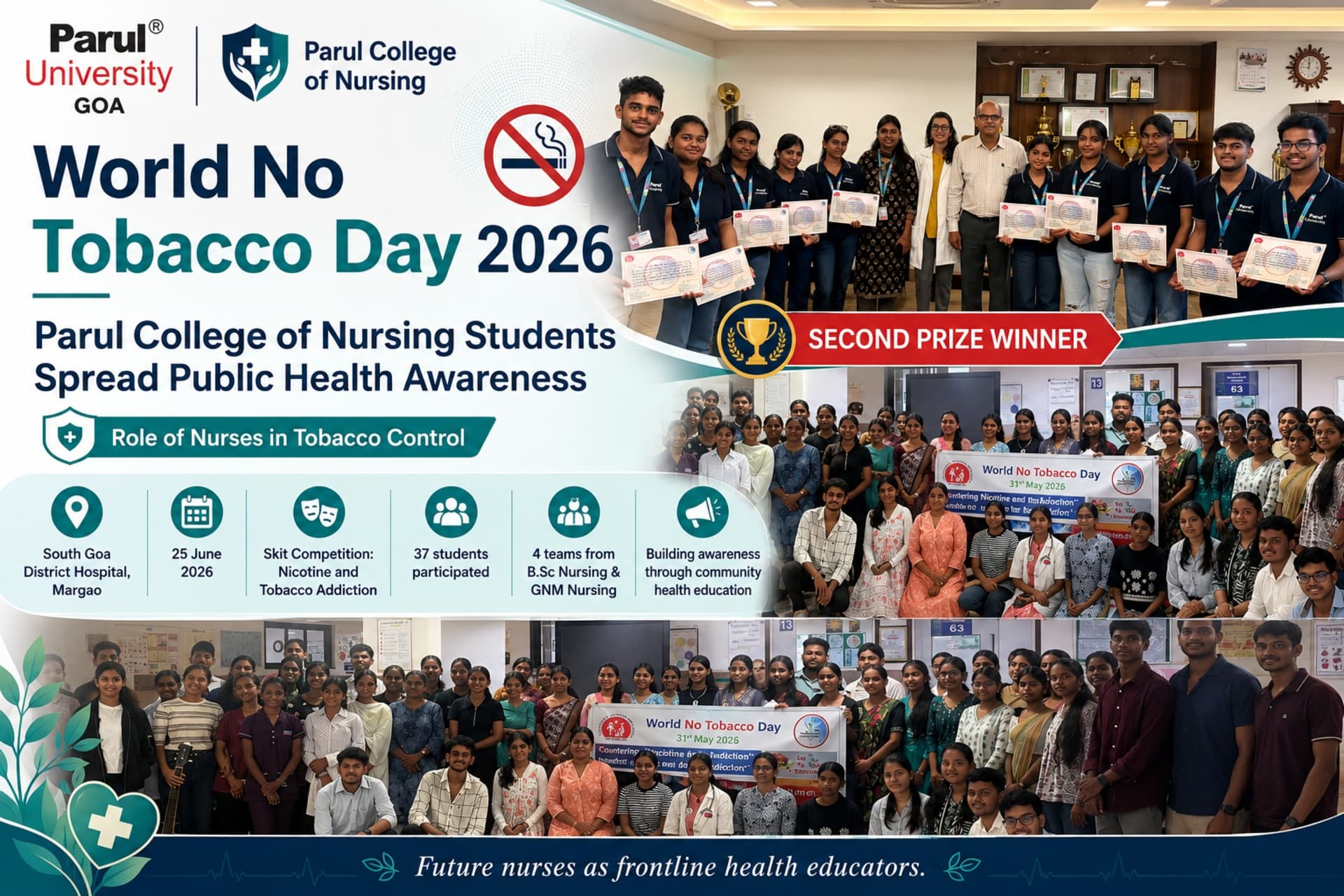
World No Tobacco Day 2026: Role Of Nurses, Parul College of Nursing Students' Skit on Public Health Education.
The Event: Health Education Outside the OPD
The skit competition, titled “Nicotine and Tobacco Addiction,” was organised by the District Tobacco Control Cell of South Goa and held in the open area outside the Outpatient Department of the South Goa District Hospital in Margao. The place of performing the skit was deliberate; it was a setting where patients, attendants, hospital staff, and visitors come. It came out as a live public health education for a real audience. The programme was inaugurated by Dr. Sarah George, District Nodal Officer for the National Tobacco Control Programme (NTCP-South), who spoke on the health consequences of tobacco and urged the nursing students to become health educators and advocates for cessation in their communities.
Six teams from various nursing institutions took part. Parul College of Nursing sent four teams to the event, two from first-year B.Sc Nursing and two from GNM Nursing, with 37 students taking part under faculty coordinator Ms. Sanjana Talekar. Through role play, emotional storytelling, and informative dialogue, each team brought out how tobacco affects individuals, families, and society. The B.Sc Nursing team went on to win Second Prize, and were felicitated by Dr. Rajendra M. Borkar, Medical Superintendent of the hospital, along with Dr. Sarah George.
Also Read: Students of Parul University Goa B.tech, B.SC visit DLinks
Why the Role of Nurses in Tobacco Control Matters
The reason this activity is more than a college event is that it reflects a genuine clinical reality. Nurses are the most numerous health workforce and the ones patients encounter most often, which places them in an ideal position to influence tobacco use. Their role in tobacco control runs across several fronts:
- Brief cessation advice: even short, structured conversations from a nurse measurably improve a patient’s odds of quitting.
- Screening and early detection: identifying tobacco-related warning signs, such as oral lesions or respiratory symptoms, early enough to matter.
- Community health education: carrying prevention messages into schools, workplaces, and public settings, exactly as the students did outside the OPD.
- Support through withdrawal: guiding patients through the physical and psychological difficulty of nicotine dependence.
What the Students Actually Taught: The Health Facts
Nurses are the health workers patients see most, and often trust most. That makes them the natural front line of cessation.
The reason this activity is more than a college event is that it reflects a genuine clinical reality. Nurses are the most numerous health workforce and the ones patients encounter most often, which places them in an ideal position to influence tobacco use. Their role in tobacco control runs across several fronts:
- Cancer: most of the tobacco consumers are in oral form; the consumption leads to oral cancer and lung cancer, strongly linked in India to smokeless tobacco such as gutka, khaini, and zarda.
- Chronic Obstructive Pulmonary Disease (COPD): Slow, Progressive, treatable but irreversible lung damage.
- Cardiovascular disease: many heart diseases and strokes are also due to tobacco consumption.
- Nicotine addiction: Any type of dependency, such as social, physical, and psychological, making the quitting process hard.
A positive message was given by students that is supported by evidence that quitting tobacco at any stage leads to a visible health improvement. That combination, honest about the harm and clear about the way out, is exactly how effective cessation counselling works.
Also Read: Goa Cloud Connect 2026 and Discussion on AI Application
World No Tobacco Day and the 2026 Theme
World No Tobacco Day is observed globally on 31 May each year, coordinated by the World Health Organization to raise awareness of tobacco’s harms and press for stronger control. The WHO theme for 2026 is “Unmasking the Appeal: Countering Nicotine and Tobacco Addiction,” which focuses on how the tobacco and nicotine industry reinvents its products, e-cigarettes, nicotine pouches, flavoured and synthetic-nicotine devices, to attract young people. The skit competition’s own title, “Nicotine and Tobacco Addiction,” aligned directly with that year’s global focus, placing a small Goa hospital event within a worldwide public health conversation.
The National Tobacco Control Programme Behind It
The event did not happen in isolation; it was run by a district cell of a national system.
India’s National Tobacco Control Programme (NTCP), run by the Ministry of Health and Family Welfare, operates through state and district Tobacco Control Cells to deliver enforcement, cessation services, and public awareness on the ground. The District Tobacco Control Cell of South Goa, which organised this competition, is one such unit, and the involvement of its District Nodal Officer is what connected the students’ work to the wider legal and policy framework, including the Cigarettes and Other Tobacco Products Act. For nursing students, taking part alongside the district health machinery is a direct lesson in how community health actually operates.
Learning Through Community Health Service
One of the agendas and related to their field give them more insights into how the health community works. This learning is beyond textbooks. The Parul College of Nursing students of Parul University of Goa learned that by standing in front of a community and communicating a health message clearly enough to change behaviour, it is not a subject that a textbook can teach. Connecting with the District Tobacco Control Cell helped students gain exposure to public health practice, widening their knowledge and strengthening their communication, leadership, and teamwork. They reinforced their identity as future health educators, not only clinical caregivers. It is the kind of experiential learning that a nursing education at Parul University Goa is built to provide.
Frequently Asked Questions
Why is the role of nurses in tobacco control important?
Why is tobacco harmful for health?
When is World No Tobacco Day and what was the theme of 2026?
What is community health nursing?
What is community health nursing? What is the National Tobacco Control Programme (NTCP)?
Related Articles
.jpg&w=3840&q=75) Careers
CareersThe Rise of Digital Health: Careers in Telemedicine and Healthcare Technology
August 22, 2026|Shashi DespandeDigital healthcare is creating new career possibilities across telemedicine, health informatics, remote patient support, diagnostics, and healthcare technology. Students with strong clinical knowledge and digital skills may be better prepared for these evolving roles.
Read More Academic
B.Sc Nursing Course Details: Eligibility, Subjects & Scope
August 20, 2026|Shashi DespandeNursing courses teach care, health skills, and provide a strong job future.
Read More
Latest Articles
.jpg&w=3840&q=75) Careers
CareersHow Data Analytics Is Becoming Essential Across Every Industry
August 31, 2026|Jennifer D'souzaData analytics is becoming relevant across industries because organisations increasingly use data to understand customers, improve operations, manage risks, and make informed decisions. This is creating career opportunities for students with analytical, technical, and business skills.
Read More.jpg&w=3840&q=75) Careers
CareersEntrepreneurship Opportunities for Students in Goa’s Growing Economy
August 25, 2026|Sritoma MukherjeeGoa’s expanding startup ecosystem is creating opportunities for students across tourism, technology, sustainability, digital services, and other emerging sectors. Building business knowledge alongside practical problem-solving skills can help students explore entrepreneurship with greater confidence.
Read More